
By Tony Davis, owner, Davis Construction & Home Improvement (MHIC #118450)
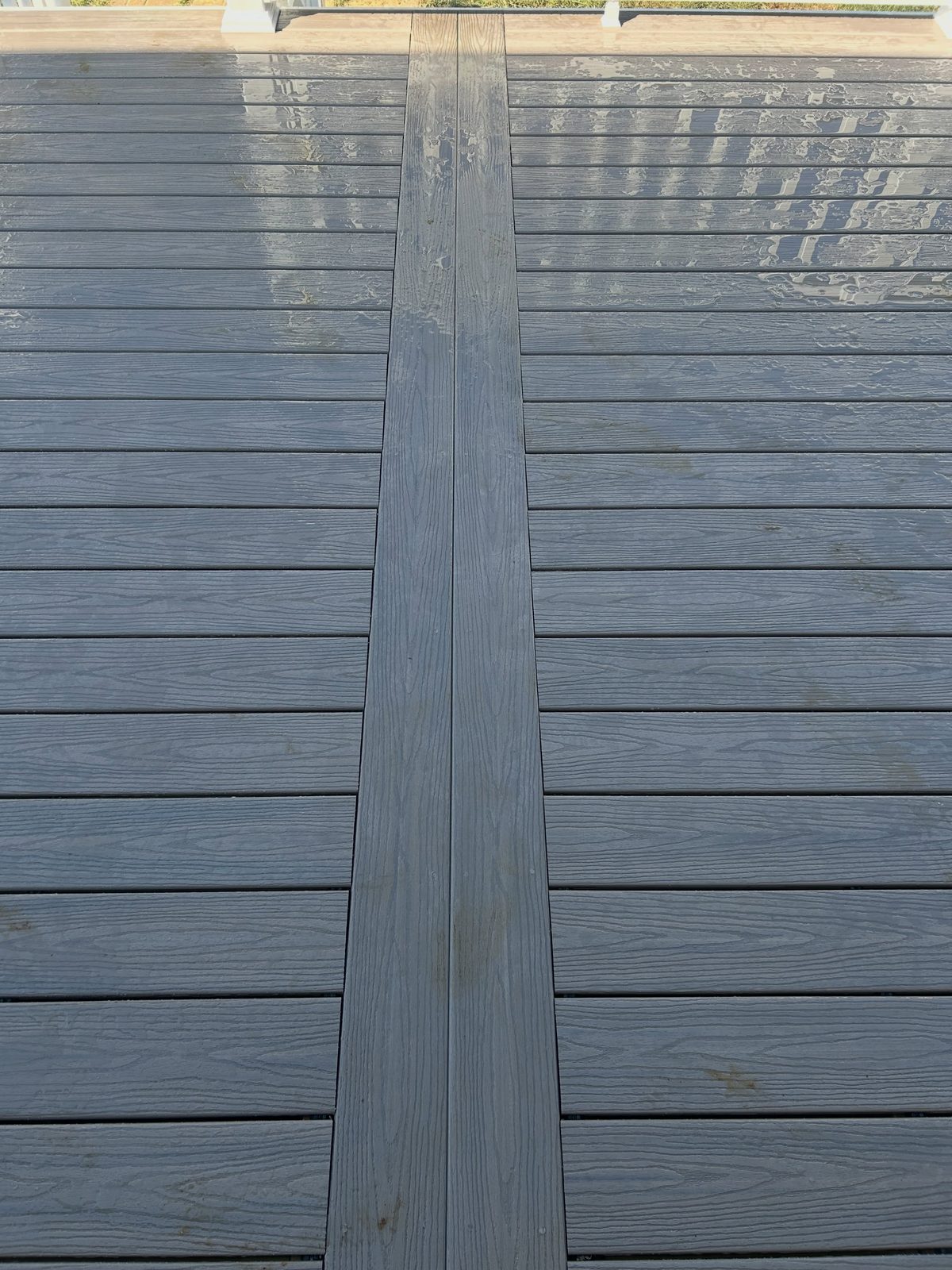
Across the open floor of every composite deck we build, the boards are held by hidden clips, so there are no screw heads on the walking surface. Steps are different. When we rebuild steps on a re-deck, the treads are face-screwed and the heads hidden under color-matched plugs. Here’s how each method works and what the manufacturers say about them.
On This Page
ToggleTwo ways to hold a board down
Face fastening means driving a screw straight down through the top of the board into the joist. Fiberon says all of its deck boards can be face-fastened.
Hidden fastening uses clips that sit in a groove cut into the edge of the board. Fiberon describes it this way: grooved boards are “secured from the side rather than by drilling a screw straight down from the top.” The clip is fastened down to the joist and holds the board edges, so nothing shows from above. Fiberon says the result is a smooth surface “like interior flooring.”
The board profile decides which method fits. Grooved boards are made for clips. Square-edge boards have no groove, so they get face screws. Fiberon notes square-edge boards are often used around the perimeter of a deck to give a solid edge facing out.
What the major clip systems are
Here are the clip systems from three of the brands we install.
- Fiberon EDGE: A Fiberon and CAMO clip designed for use on all grooved decking, including PE and PVC, for 90-degree deck patterns. Fiberon says the clip’s gusset sets a 3/16-inch gap and holds the board down. For any deck pattern, Fiberon points to EDGEX on wood framing. When we install Fiberon, those two clips are what we use.
- TimberTech CONCEALoc: TimberTech says it’s made from SAE 304 stainless steel and designed exclusively for TimberTech grooved composite boards. TimberTech notes it isn’t compatible with steel or aluminum framing.
- Trex Hideaway: Glass-filled nylon clips with a preset stainless steel screw, used to install Trex grooved-edge boards “with no visible screw heads on the walking surface.” Trex says a box covers 50 square feet with boards installed 16 inches on center.
The gap matters. Fiberon says consistent 3/16-inch gapping between boards allows for thermal movement and drainage, and that its hidden fasteners ensure that gap.
Why we use hidden fasteners on composite
Clips keep screw heads off the walking surface and set consistent spacing between boards. Hidden fasteners are our standard on composite, and because hardware is included in every deck total, the clips cost you nothing extra.
Why steps get screws and plugs
Steps are a special case, and here’s the reason in Tony’s own words: “load transfer — your body weight doubles as you walk up and down steps, so they take the worst wear and tear.”
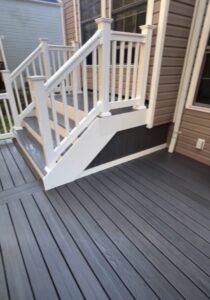
That’s why we always rebuild steps completely on a re-deck, and the rebuilt steps are screwed down and capped with color-match plugs. The screw goes down through the tread, and a plug made to match the board covers the head. Fiberon’s fastener guide lists one such system, Starborn’s PROPLUG: you drill and set each screw, then tap in a color-matched plug made from Fiberon decking material. It works with Fiberon’s PE and PVC boards.
Steps are rebuilt on all of our re-decks. Here’s what each 4-foot-wide step costs:
| Tread style | Each step (4 ft wide) |
|---|---|
| Basic composite | $350 |
| Mid-range composite | $450 |
| Top-tier composite, lights built in | $550 |
| Wood tread | $330 |
| Wood tread with step lights | $530 |
A note on screw material
The metal matters too. For salt air, pools or other corrosive areas, Fiberon advises 305 or 316 stainless deck screws. Fiberon also offers Cap-Tor xd color-matched screws in epoxy-coated carbon steel or 305 stainless steel. On our builds, the rule is stainless steel within 300 feet of salt water and hot-dip galvanized everywhere else. Your county’s adopted building code and its inspector have the final say. Building near the water or a pool? Mention it during the estimate so hardware is part of the conversation from the start.
Picture frames and fascia
A single-row border frame with breaker boards comes standard on every deck we price; doubling both the frame and the breaker adds about $1,500. Fiberon notes it has color-matched screw and plug systems for fascia, some of which also work on risers. Borders and other upgrades are covered in our custom features overview.
Fastener Questions We Hear
Are hidden fasteners as strong as screws?
None of the manufacturer pages we checked publishes a head-to-head strength figure for clips versus face screws. Fiberon does say its EDGE clip’s gusset is up to 88% stronger than competitors’ clips in lateral movement tests.
Can I mix brands of boards and clips?
Go by the board maker’s instructions. TimberTech, for instance, says CONCEALoc is designed exclusively for TimberTech grooved boards.
Do hidden fasteners cost extra with you?
No. Clips and screws are built into every total on our pricing page, the same as the railing, the permit and demolition of whatever deck is there now.
Borders are where fastening gets tricky; see our picture-frame border post. Clip choice can also tie into coverage, covered in composite warranty fine print.
See the difference up close
We bring product samples to estimates, so you can see and handle the boards in person. Set up your visit, or reach Tony’s line, 240-794-2274. One more thing: our military discount takes 10% off (the cap is $1,000) for anyone who’s a veteran or serving now.
Sources: Fiberon: How to Choose Composite Decking Fasteners; Fiberon EDGE Hidden Deck Clips; TimberTech CONCEALoc Hidden Fastener; Trex Hideaway Universal Hidden Fasteners. Prices, step method and inclusions are from Davis Construction’s own price list.