
By Tony Davis, owner, Davis Construction & Home Improvement (MHIC #118450)
Pressure-treated wood costs less to build, and composite asks far less of you once it’s built. On a 12×12, our entry composite deck costs $1,440 more than the same deck in wood; on a 16×40 the difference grows to $6,400. What you get for that money is a long manufacturer warranty and no annual sealing.
On This Page
ToggleWood and composite, priced side by side
| Material | 12×12 | 12×25 | 16×40 |
|---|---|---|---|
| Pressure-treated wood | $10,080 | $21,000 | $44,800 |
| Composite, entry (Fiberon Good Life Weekender, Deckorators Venture) | $11,520 | $24,000 | $51,200 |
| Composite, mid (Fiberon Sanctuary, Trex Enhance Naturals, TimberTech Prime+, Deckorators Vista) | $12,960 | $27,000 | $57,600 |
| Composite, top fixed price (TimberTech Terrain+) | $14,400 | $30,000 | $64,000 |
Those are finished-deck figures, start to finish: rails, labor, lumber or boards, hardware, permit, footings, and getting rid of the old deck. Other composite tiers sit between these rows; see our deck pricing page for all of them.
The extras cost a little more in composite, too
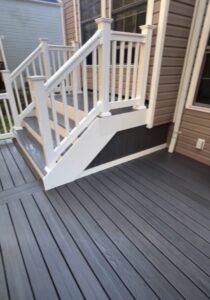
Steps and landings follow the same pattern. A 4-foot-wide wood step is $330, or $530 with lights. Composite steps run $350 for basic, $450 for mid and $550 for top (lights included on top). Wood landings (4×4) run $1,320; composite landings are $1,500, $1,800 or $2,400.
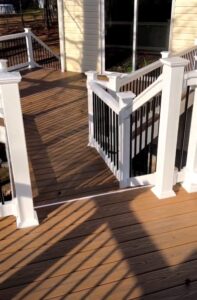
Railings are included either way, just in different styles. A wood deck comes with a standard wood railing. A composite deck comes with a standard white vinyl railing. Upgrades such as black aluminum pickets or cable are add-ons on both — details on our deck railings page.
How we build a wood deck
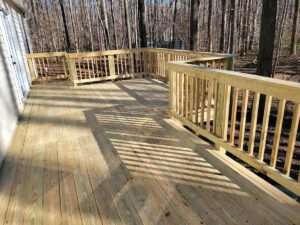
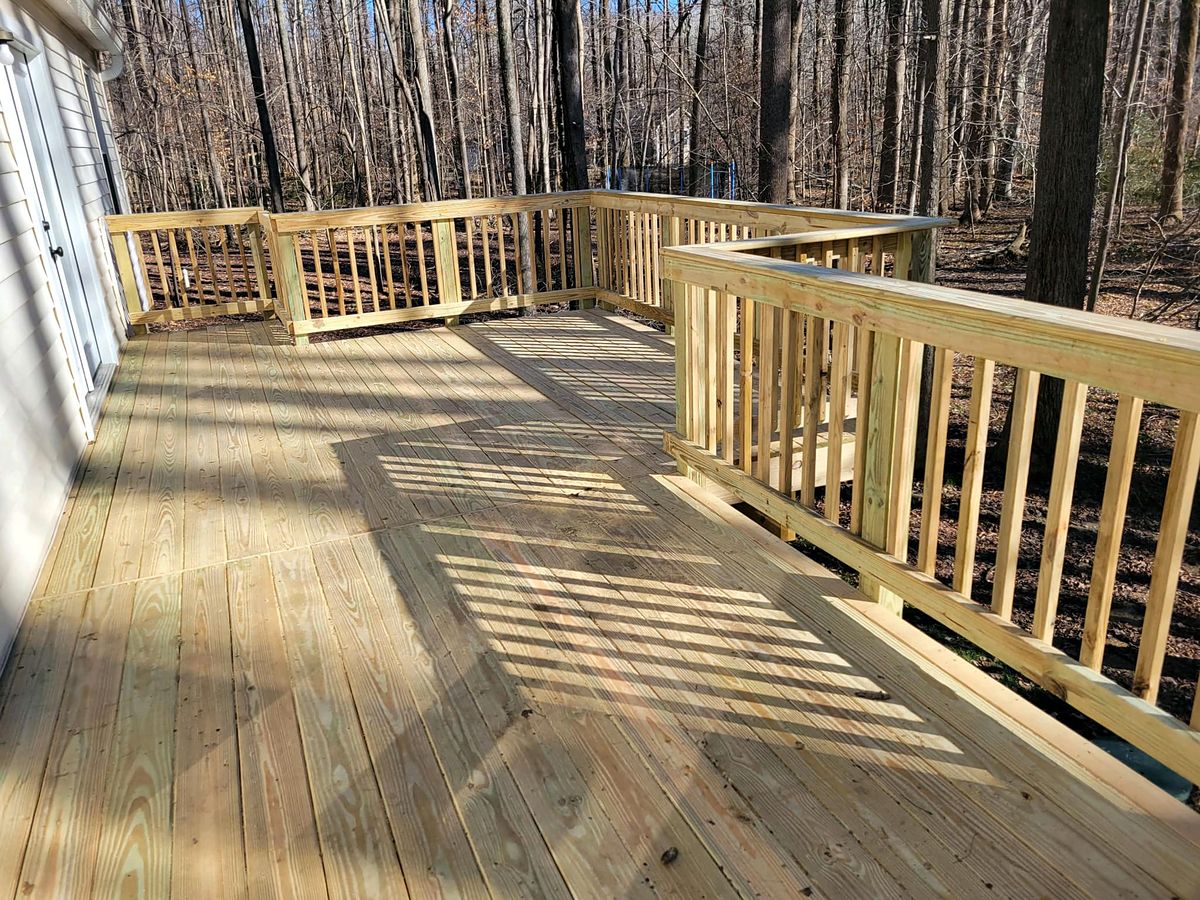
The framing underneath is the same whichever surface you pick: wood decks and composite decks alike sit on pressure-treated lumber rated for ground contact and graded No. 1.
- Deck boards: your choice of 5/4 (five-quarter) or 2×6.
- Railing: plain wood, wood with black aluminum pickets, or cable — your call.
- Footings: dug 24–30 inches down and 18 inches across.
- Permit: pulled by us for every deck, and we handle the footing, framing and final inspections.
More detail is on our pressure-treated wood decks page.
What upkeep looks like for each
Wood
YellaWood, a pressure-treated lumber brand, wants a water repellent on the boards inside the first six weeks after the build, then again every year. Any stain you use should have repellent in it and gets redone when it needs it. For timing, YellaWood’s sprinkle test works: flick some water on the deck — beading means give it a few more days, soaking in means go.
For washing, YellaWood calls for mild soap and a pressure washer turned down low, a 45-degree fan tip, and a wand that never stops moving. It also folds a fastener check into routine care, and says a board too warped or split to save should simply be replaced.
One more thing from that same YellaWood page: natural wood behavior such as shrinkage, checking and warping is not warranted against.
Composite
The composite makers describe a much lighter routine. Fiberon’s Good Life and Sanctuary pages say the boards go without sanding, stain or paint for their whole life, and routine dirt comes off with soap, water and, if needed, a mild cleaner. TimberTech says Prime+ needs only occasional scrubbing and rinsing, with no sanding, staining or sealing.
Don’t go the other direction and coat composite, though. Trex and TimberTech each say in writing that applying paint or other coating materials voids coverage on their boards; TimberTech names stain in that list too.
Warranty: the real dividing line
Every composite line we price carries a manufacturer warranty measured in decades — 25 years at minimum, and 30, 35 or 40 years on several lines, per each maker. On the wood side, the YellaWood note above is the key point: natural movement like checking and warping isn’t covered. Either way, Davis Construction backs the build itself for one year.
Which one should you build?
Wood makes sense if the budget is tight, you don’t mind a yearly coat of water repellent, or you like the idea of re-staining to change the look later. Composite makes sense if you’d rather spend that weekend on the deck instead of working on it, or if a long fade-and-stain warranty matters to you. With Tony’s Trex, TimberTech and Fiberon certifications, plus Deckorators installs, the composite side has plenty of choice.
Wood vs composite FAQ
How long after the build should I seal a new wood deck?
Inside the first six weeks, per YellaWood. Do the sprinkle test first — if the water soaks in, the wood is ready.
Can I stain composite boards to change the color later?
Trex says applying paint, solvents or other coating materials voids its warranty, and TimberTech says the same of paint, stain or other coating materials, so pick a color you’ll be happy with. We bring samples and a free 3D drawing to help.
How long does a deck take to build?
Our build times are set by size: two to three days for a 12×12, three to five for a 12×25, six to eight for a 16×40.
Looking above composite? See composite compared with PVC. Going with wood? Read how to maintain a treated deck and which board size to pick.
Get both numbers for your deck
Ask for your deck priced in wood and in composite so you can compare. Pick a time for your free estimate or give Tony a call at 240-794-2274. If you’ve served or are serving now, tell us at the estimate — that’s 10% off, up to $1,000.
Sources: YellaWood care & maintenance; YellaWood sealing pressure-treated wood; Fiberon Good Life; Fiberon Sanctuary; TimberTech Prime+; Trex Decking Limited Warranty (linked from trex.com/warranty); TimberTech composite fade & stain limited warranty; Trex warranty years by line; Fiberon warranty years; Deckorators decking limited warranty. Prices and process come from Davis Construction’s own price list.