
By Tony Davis, owner, Davis Construction & Home Improvement (MHIC #118450)
In code language, a deck railing is a “guard,” and whether you need one starts with height: Calvert’s summary of its adopted code ties the guard rules to the part of a walking surface more than 30 inches above grade. The guard rules (Section R312) come from whichever International Residential Code edition your county adopted, and in Southern Maryland that isn’t the same edition everywhere. Below: what the three counties’ own code documents confirm, how we build, and the price of each railing upgrade.
On This Page
ToggleFirst: which code is your county on?
- St. Mary’s County: 2021 IRC, effective July 15, 2024, per the county’s construction-codes FAQ.
- Charles County: 2021 IRC, for permit applications received on or after June 28, 2024 (Bill 2024-10).
- Calvert County: 2018 IRC, effective July 1, 2022.
The edition your county adopted, with its local amendments, is the one that applies to your deck.
When a deck needs a guard
Calvert County’s summary of the 2018 IRC changes puts it plainly: “The guard requirements only apply to the specific portion of a walking surface that exceeds 30 inches above grade.” That clarification matters on sloped yards. One end of a deck can sit low and need no guard while the far end, where the ground drops away, does.
Every deck price we quote includes railings, whether the deck is 12 inches off the ground or a full story up.
The 4-inch sphere shows up in St. Mary’s stair rule
St. Mary’s County’s 2024 building code ordinance amends the stair section of the 2021 IRC, and it includes a rule for open risers: on stairs that stand over 30 inches above what’s beneath them, the openings “shall not permit the passage of a 4-inch-diameter (102 mm) sphere.” So if you like the look of open stairs on a tall deck, the gaps between treads are limited.
Guard height and baluster spacing
The minimum guard height and the maximum opening between balusters come from your county’s code edition. We weren’t able to open the ICC’s code text directly while writing this, and none of our three counties’ pages we reviewed restate those two numbers, so we’re not going to quote them from memory. Here’s how it works on a Davis job instead:
- Every deck we build is permitted, and we pull the permit.
- We handle the footing, framing and final inspections and try to be there when the inspector comes.
- Your county’s adopted building code and its inspector have the final say.
For reference on products, Trex lists its Signature aluminum railing kits in 6-foot or 8-foot lengths and 36-inch or 42-inch rail heights. Which height your deck needs is a code question for your county, not a style choice.
What comes standard, and what upgrades cost
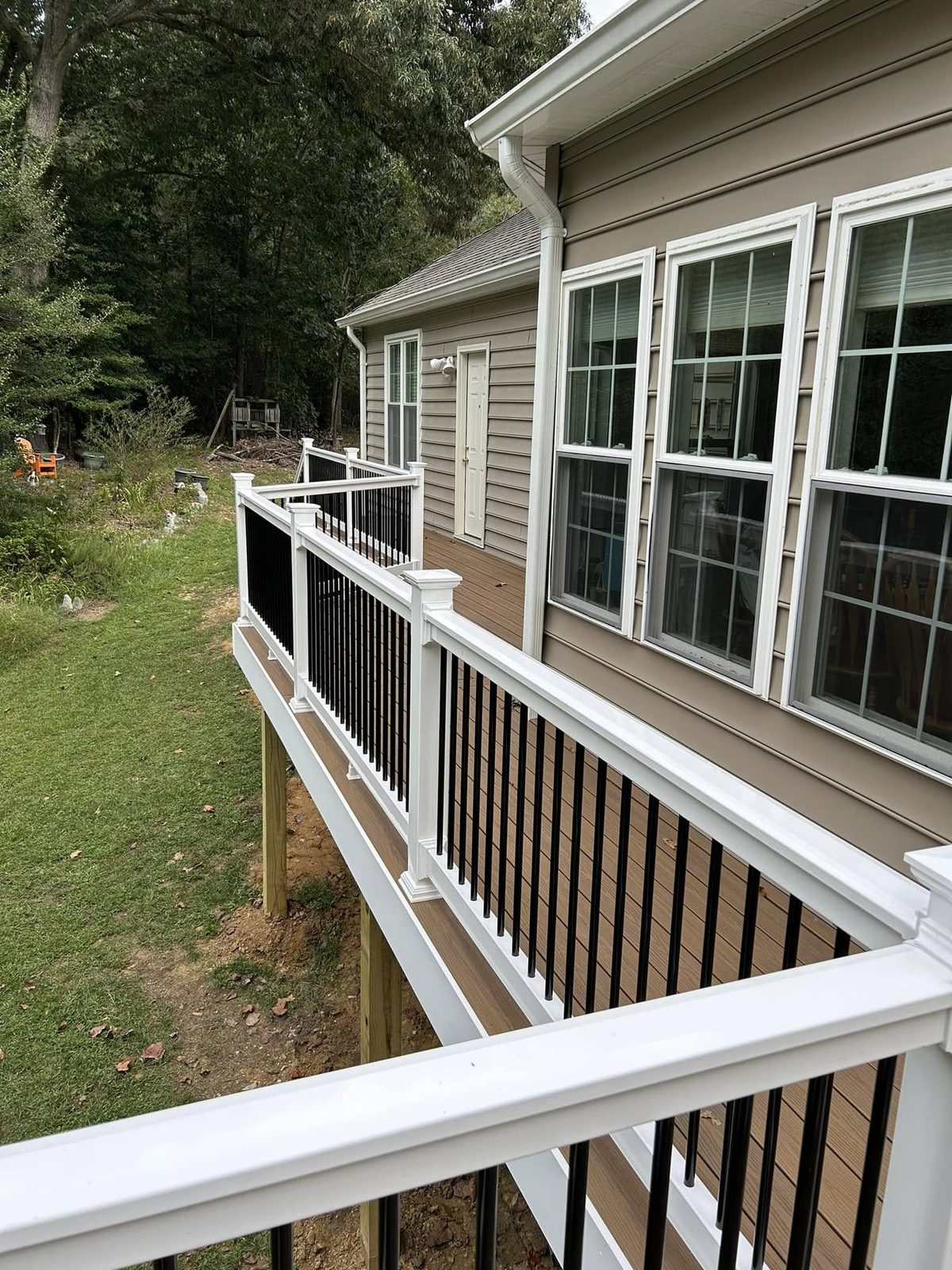
On a pressure-treated wood deck, a standard wood railing is included. On a composite deck, a standard white vinyl railing is included. Wood deck owners can also pick wood with black aluminum pickets, or cable.
| Railing upgrade | Price |
|---|---|
| Black aluminum pickets in place of standard infill (white or wood rail stays) | Add $50 for each 6–8 ft section |
| Drink rail on top | Add $75 a section |
| Cable infill | Add $200–$300 a section; a complete cable system is about $500 a section installed |
| All-aluminum black railing | Around $500 a section, installed |
| Solar caps for posts | $25 each basic; up to $50 mid; up to $75 top of the line |
| Deck gate | $500–$550 apiece |
We don’t guess at section counts in a blog post. How many sections your deck has depends on its shape, stairs and post layout, and those come out of your deck’s layout and the free 3D drawing that comes with your quote. Browse the styles on our deck railings page, and deck totals with the standard railing already in them on our deck prices page.
Railings on raised decks
Taller decks cost more to build in general. Second-story decks run about 25% more, and third-story decks about 30–35% more. Our multi-level decks page covers how pricing works when a deck has more than one level.
Railing code questions
My old deck’s railing passed years ago. Is it still OK?
Codes change between editions, and all three of our counties have adopted a new edition within the last several years. When we re-deck, the railing is always replaced with new, and the job is permitted and inspected like any other deck we build.
Do stairs need a guard too?
Calvert’s summary ties the guard rule to walking surfaces more than 30 inches above grade, and a long run of stairs can climb past that. Handrail and stair-guard details depend on your county’s code edition. Your county’s adopted building code and its inspector have the final say.
Is cable railing allowed?
Cable is one of the railing options we offer, priced in the table above. It still has to meet the same code as any other guard on your deck.
Keeping kids or a dog off the stairs? See our post on deck gates.
Pick your railing with samples in hand
Railing is easier to choose when you can see it. Tony brings product samples to each estimate, and a no-cost 3D drawing is part of every quote. Set a time for your free estimate or call 240-794-2274. Veterans and active-duty troops: 10% off, as much as $1,000 in savings.
Sources: Calvert County, Building Code Adoption (2018 IRC; R312.1 guard clarification); St. Mary’s County FAQ 9, Construction Codes in Effect; St. Mary’s County 2024 Building Code Ordinance (R311.7.5.1 open risers); Charles County Notice #24-01, 2021 Building Code Update; Trex Signature Railing. Prices and process come from Davis Construction’s own price list.